Thursday, 4 July 2019
The John Muir Way 3-6 July 2019
The cycle route much of the time follows the same tracks as the walking route. On the first day Itrained it to Helensburgh to have a chance of the wind behind me. First stop was Rennie And Margaret Mackintosh’s The Hill House on the inland edge of Helensburgh, with beautiful views over the Forth of Clyde and consequently very exposed, which is the problem.

Sunday, 30 September 2018
2018-08-02 The glorious Northumberland coast - 87 miles
National Cycle Route 1 runs from Dover to the Shetland Isles and although I have followed it through South Tyneside, on the Tyne Ferry and to to just north of Whitley Bay, I had so far not managed the remainder of its route through Northumberland. Tom Elliott was about to depart for a contract with Cairn India as a drilling fluids specialist, so it made sense (really?) to cycle to Whitley Bay to see him. His family were pitmen in Ashington and it was fitting that he should have chosen to pursue a geology degree at Durham, where I first met him forty odd years' ago. Then he went into the oil industry rather than coal, which was already in steady decline.
Google Maps (how we have come to rely on it) suggested that it might be 74 miles by bike, so that seemed manageable, but I set off at 07:10 to be on the safe side (ha!). I decide to take my Surly Disc Trucker touring bike, having walked the Berwick to Lindisfarne part of the route in March and found too much in the way of rocks and gravel to make it suitable for road bikes.
My usual route from home is a great start: along the cycle path at the top of the golf course with great views over the North Sea. Then in through the Elizabethan gate of the Ramparts and down Ravensdowne, our best Georgian street, across the 17th Century Old Bridge and through Tweedmouth and Spittal. It is fair to say that quite a lot of the route after that is inland, with only occasional seaside stretches and often more distant views of the sea, if any. The route crosses and re-crosses the A1 to avoid as much traffic as possible.
Google Maps (how we have come to rely on it) suggested that it might be 74 miles by bike, so that seemed manageable, but I set off at 07:10 to be on the safe side (ha!). I decide to take my Surly Disc Trucker touring bike, having walked the Berwick to Lindisfarne part of the route in March and found too much in the way of rocks and gravel to make it suitable for road bikes.
 |
| Image provided by Laura G: a vicious slur |
After 25 miles I still felt pretty good and stopped in Bamburgh for coffee and cake and at Carter's the Bamburgh Butcher for supplies: a sizeable pork pie for lunch and a sausage roll to take home for Cath.
 |
| Courtesy of R. Carter & Son's website |
The weather grew hotter and my litre of water was soon depleted. There is more climb than might be expected, as this is very rolling countryside. Soon after Bamburgh, there is an interesting tower, now converted to holiday accommodation. It was possibly a folly but some maps suggest that it may have been used as a landmark for navigation.
 |
| The Outchester Ducket |
After this the route passes through Seahouses and Beadnell. These are both rather smarter than in July 1977 when Cath and I experienced our first holiday together. a very wet camping trip, which culminated in our first visit to Berwick-upon-Tweed. 40 years later we retired here. And so onward, close by Low Newton and Dunstanburgh, Craster and, since I avoided the coastal route, past the entrance to Howick Hall, where we visited the excellent arboretum in May for Cath's birthday. Then past RAF Boulmer to classy Alnmouth.
 |
| Poor image of Phantom Jet at Boulmer - in service 1969-92 |
I grew very confused in trying to get out of Almmouth and had to backtrack three times. I was getting hungry but I pressed on to Warkworth, wondering whether I could do much more but the outstanding pork pie and more water worked their magic. A lady asked me from whence I came and was startled when I said Berwick, destination Whitley Bay. It was already becoming clear that, despite its claims to be via Route 1, Google Maps followed a much attenuated route. My own slavish, or cravenly accurate route, was more exacting.
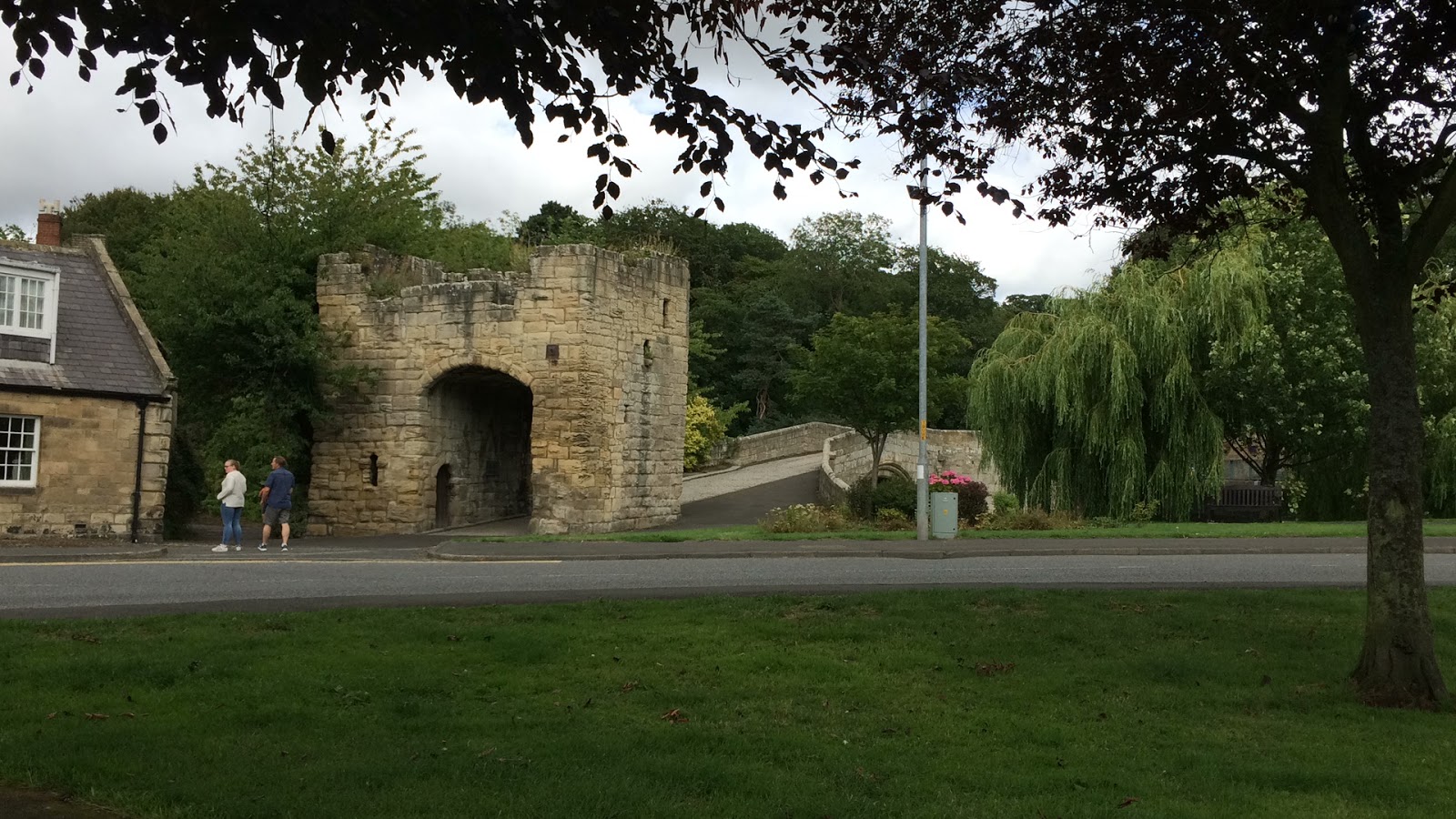 |
| Warkworth old bridge and gatehouse |
Along the ever-smarter high street and past the excellent castle, I headed back to the coast and down through Amble. It too has perked up following the harbour development and the main shopping street looked spruce and fully let with independent shops that seemed to be holding their own. Even the perenially excellent Harbour Fish Bar has had a face lift.
The next stage of the trip followed the magnificent sweep of Druridge Bay. After stopping for much-needed water at the Drift cafe (chaotic), I cycled past the power station at Lynemouth (commissioned 1972 by Alcan to power their nearby aluminium smelter), once supplied by the nearby Ellington and Lynemouth collieries but now a biomass-fed plant connected to the National Grid following the mothballing of the Alcan plant in 2012. The route south through Ashington to Blyth passes the Woodhorn Colliery mining museum. Tom arranged for me and Caradoc Bevan to be elected members of the Linton and Woodhorn Social Club (CIU Affiliated) in 1975, so that we could all drink at other social clubs in the North East, taking advantage of the cheap Federation Ales then produced by a co-operative to avoid being ripped off by the big brewers. The brewers, of course, were in league with the bosses. Happy days.
It has to be said that the dual carriageways and bypasses in this section of the ride were very difficult to navigate and confusing as hell but I eventually used a pavement route into the centre of Blyth to avoid the very busy roads. The cycle route took me through Ridley Park, the name being a clue to the land ownership. The Ridley family are still coal barons in this area, the vast existing opencast mine at Shotton being part of their Blagdon Estate. Matt Ridley, 5th Viscount Ridley, is the former Chairman of Northern Rock, who led it to financial disaster in 2007, as the last in a long line of his family in this role. He is well known as a rightist libertarian pundit and academic.
Well, Ridley Park in Blyth, although modest, is lovely and is bordered by rather good late Victorian and Edwardian houses; coupled with the Council's investment at the docks, Blyth is looking good and it even has a seaside that I knew nothing about. Given the high cost of houses in Whitley Bay, Tynemouth, North Shields and Morpeth, it seems likely that buyers are showing increasing interest in Blyth. What a change: Blyth has been at a low ebb for a very long time.
I arrived in Whitley Bay nearly three hours late at 17:45 and drank vast amounts of tea before Tom took me to Central station for my train back to Berwick. I briefly met Vivian, his charming Nigerian wife, before we left and she was disappointed that we had been unable to visit the restored Spanish City, which has been shut up for so long.
I had never cycled this far before in a single day and my bottom was sore but the sausage roll was intact and edible despite jumping out of my bar bag near Blyth.
Wednesday, 11 July 2018
2018-07-06 Berwick-upon-Tweed to Edinburgh by road bike over the Lammermuirs
The distractions of moving to Berwick-upon-Tweed, setting up house and working on yet another Edwardian house have resulted in a blog famine but no longer. In the past year I have cycled more than ever, largely as a result of joining the Puffin Cycling Group, essentially social but still going rather faster and with more of a concern for appropriate bikes and kit than I had previously pursued. I have tried to keep up with them on a hybrid and a mountain bike but neither is really workable, even in the medium speed group (10-13 mph), which is all I aspire to.
So, dear reader, I spent £200 on Ebay for a secondhand road bike, for sale through Cash Converters in Dundee. Perhaps a student was raising some cash, having become indebted through involvement in a late night poker school or via the snares of online gambling. This low cost and little used miracle of modern cycling is a B'Twin Triban 3, an entry-level alloy road bike with carbon forks and a basic Shimano drive train. It is a surprisingly good and well-regarded product from Decathlon, the mostly cheap and cheerful French sports chain but they also sponsor the Tour de France, have a research team and offer some reasonably high-end road bikes. Weighing about 10 kilos, the performance is markedly better than a touring bike or hybrid and I suspect that this is a combination of lightness, gearing that matches the other road bikes in my group, and stronger leg muscles from our Sunday morning outings, as well as other forays.

I attempted to cycle to Edinburgh last year, following a coastal route on my fairly basic 29-inch Felt mountain bike. A combination of a slow puncture from the accursed power flailing of hawthorn hedges along the route together with energy loss through the un-lockable suspension on the front forks, left me knackered by the time I reached Dunbar. I threw in the towel and caught the train to Edinburgh, went to the pub and caught the pre-booked train back to Berwick, as planned.
This year I decided to try the hard way, via Duns and over the Lammermuir hills. The over-dramatic graph below shows the profile. This is the route that I plotted on ViewRanger, generally a very good GPS based app for planning and recording what you do. More detail via the link below.
http://my.viewranger.com/route/details/MTg4MzAzNw==


National Cycle Route 1 passes the end of our street and I followed part of it through Paxton and then cross country over the river Blackadder to Duns, a lovely little market town of which we had not even heard before we started to look for houses in this area. It was the home of Jim Clark, the Formula One racing driver who died at only 32. The town has no less than three significant country estates: Duns Castle, built around a former pele tower (this is the land of the border reivers and fortification was obligatory for survival), Manderston, a lavish Edwardian mansion with a silver staircase and Wedderburn Castle, which I only found by accident just before my first spill of the day, when I unwisely attempted to start off uphill into Duns in cleats. A kind young man in a pickup stopped to ask whether the old gentleman had suffered harm. The old gentleman thanked him for his solicitous intervention and answered in the negative, feeling a right tit.
Unfortunately Duns is where the really hard climb begins. Hardens Hill is not particularly steep but it is relentless. I knew what to expect, having struggled up it with the Puffins a couple of weeks previously and managed fairly well for an older guy with fairly crap lungs. Luckily the even more demanding hill that I did with the Puffins was off on a side road before the wonderfully-named Longformacus through which, by turns and across a cattle grid, I ground upwards towards the top of the Lammermuir Hills. There is some heather but it is mostly kept back by sheep and there are various small squares of cultivated land, apparently some type of experiment. There were also young partridges, wandering about rather than flying. The lavish collection of roadkill that I passed mainly consisted of rabbits. This was the countryside that Sir Walter Scott had in mind as his setting for The Bride of Lammermoor. His house at Melrose is not far away. In my view he is vastly overrated and even reading standing up, I found it difficult to stay awake when attempting Waverley.


So, dear reader, I spent £200 on Ebay for a secondhand road bike, for sale through Cash Converters in Dundee. Perhaps a student was raising some cash, having become indebted through involvement in a late night poker school or via the snares of online gambling. This low cost and little used miracle of modern cycling is a B'Twin Triban 3, an entry-level alloy road bike with carbon forks and a basic Shimano drive train. It is a surprisingly good and well-regarded product from Decathlon, the mostly cheap and cheerful French sports chain but they also sponsor the Tour de France, have a research team and offer some reasonably high-end road bikes. Weighing about 10 kilos, the performance is markedly better than a touring bike or hybrid and I suspect that this is a combination of lightness, gearing that matches the other road bikes in my group, and stronger leg muscles from our Sunday morning outings, as well as other forays.
I attempted to cycle to Edinburgh last year, following a coastal route on my fairly basic 29-inch Felt mountain bike. A combination of a slow puncture from the accursed power flailing of hawthorn hedges along the route together with energy loss through the un-lockable suspension on the front forks, left me knackered by the time I reached Dunbar. I threw in the towel and caught the train to Edinburgh, went to the pub and caught the pre-booked train back to Berwick, as planned.
This year I decided to try the hard way, via Duns and over the Lammermuir hills. The over-dramatic graph below shows the profile. This is the route that I plotted on ViewRanger, generally a very good GPS based app for planning and recording what you do. More detail via the link below.
http://my.viewranger.com/route/details/MTg4MzAzNw==

The route is a little over 60 miles with about 3,400 foot of ascent and most of the time I saw very little traffic. The Scottish Borders are a wonderful place to cycle, with lots of quiet back roads, rolling countryside and only very small towns and villages.
 |
| View towards the Lammermuirs |
 |
| Wedderburn Castle gate |
Once across the uplands, the view is to the hills beyond the Firth of Forth, always magnificent but even more striking from this height. The rather uninspiring photograph below perhaps does not do justice.

And so onward towards Edinburgh through villages such as East and West Saltoun past the Glenkinchie distillery (no, that way madness lies) and onto the long distance cycle path on the former Pencaitland railway. Like much of the rest of the borders, most of the land appears to be in the ownership of large agricultural estates with private 18th Century parks surrounded by stone walls. Presumably wall building was infill work for the agricultural staff on these estates. The effect is a clear message: Private Keep Out. Because warfare between the Scots and the English and the running battles between the reiver families prevented the development of the border lands for so long, the 18th century and early 19th experienced a distinct peace dividend. However, the sparse population and large estates meant that efficient agricultural innovations promoted by Charles Viscount "Turnip" Townsend and others were much more readily adopted here, greatly increasing revenues and values.
Pencaitland is by Dalkeith, smallest of the estates of the Duke of Buccleugh (big in the Borders) but because this rich agricultural land was dense with coal seams, it was also, ahem, the heart of Midlothian's coal mining industry. From here there are marked cycle paths all the way to Edinburgh city centre, much of it on our old friend NCR1 but also often coinciding with The John Muir Way, a coast-to-coast route from Helensburgh on the Firth of Clyde to North Sea fishing port Dunbar. This port was the birthplace of John Muir, founder of the Scottish National Trust. Helensburgh at the other end is close by Loch Lomond, the first Scottish national park, which Muir worked to create.
Everything feels very urban as the route heads towards Musselburgh on the Firth of Forth and then turns towards the city centre, sometimes on roads but also on dedicated cycle paths including former railways, with a long, dark tunnel after it passes below the Salisbury Crags on the south side of Holyrood Park. Once I reached Waverley Station (Scott again), I put the bike in a rack, had a wash and change in the gents toilets with 50 minutes to spare for a much-needed pint of bitter at the Abbotsford (more Scott) in Rose Street, just behind Jenners. Then back past the Scott Memorial, a sort of blackened Victorian space ship and onto a very crowded train to Berwick, the 45-minute journey's rather putting in context my whole day of cycling. The LNER staff couldn't have been nicer and the enthusiastic guard had my bike waiting for me on the platform when I scuttled back to coach B to collect it. A grand day out.

Sunday, 3 July 2016
2-4 June Offa's Dyke - Chepstow-Pandy 40 miles
I have been walking on and around the Offa's Dyke long distance path for perhaps 30 years with my very old friend Anthony Farnsworth. Mostly we meet in May or June for a walking weekend, usually involving a couple of short urban walks and a longer rural walk, often on the Dyke path itself. We have not tackled the northern half of the walk together, mostly exploring those parts south of Bishop's Castle.
This time we decided on a two day walk with 3 overnight stays and the weather was pleasant, if a little stifling on Saturday. I had never explored Chepstow before, a pleasant market town but with a lot of new estate development. The river Wye and the forbidding castle are the most striking features. Chepstow is doing pretty well. The river, which has a dramatic tidal rise is crossed by an elegant iron mid-Victorian bridge and the walk up above the river is beautiful, mostly through woods with views down into former quarries and a classic view over Tintern Abbey. We met various long distance walkers on our trip, some from New Zealand and Canada.
There is considerable climb and descent on this first leg of the walk and the route passes through the Forest of Dean before reaching Monmouth, another excellent market town with a good ironmongers, as previously noted, this is a high point and market for both of us. The town is somewhat dominated by Monmouth School and has both the Monnow and the Wye as features, There is a wonderful 13th Century bridge and fortified gatehouse over the Monnow. We decided to have a curry and the Misbah Tandoori appears as number 4 restaurant in Monmouth on Trip Advisor but although well run, clean and with prompt service (from Monmouth School 6th formers) the un-marinated tough lamb and sugared massala sauce spoiled the meal for me.
The following day, after an excellent breakfast from Penny Dawes at Ebberley House B&B, we strode off on the final leg to Pandy, just below the Black Mountains. Actually, I walked with care rather than striding, as I had been cavalier in carrying too heavy a pack and blisters were a bane on both days. My feet had softened after a month on a bike and the final few hours of the walk were a trial. The route had far fewer climbs and mainly went through farmers' fields. The high point of the afternoon was a pint of Wye Valley Brewery IPA at the Hunter's Moon Inn at Llangattock Llangoed, rarely so welcome.
Cath said that I looked like a weary little old man as I shuffled gingerly up the drive of our friends Cedric and Fran Mathison, who live a mile from Pandy on the River Monnow and who were generously putting us up. A restorative dinner was entirely welcome and the presence of two visitors in their 20s added life to the table. They were going on with the father of one to cycle 60 miles from Port Talbot the following morning.
I took Antony to Abergavenny station on Sunday morning for his return to Exeter. Cath, Cedric and I had a community lunch at the village hall in Walterstone with many lively and excellent senior women of the parish. Fran was helping with service in a stalwart fashion. They know everyboddy, despite having only been there 4 years, intrepid social creatures that they are. The return journey was a trial, mostly on the A49 to avoid the vileness of the M6, but that went well. The problem was that the air conditioning on our aged Prius needs re-gassing and this had only been revealed during this, the first hot spell of the year. Returning to the coolth of our east facing sitting room was a welcome end to the day.


This time we decided on a two day walk with 3 overnight stays and the weather was pleasant, if a little stifling on Saturday. I had never explored Chepstow before, a pleasant market town but with a lot of new estate development. The river Wye and the forbidding castle are the most striking features. Chepstow is doing pretty well. The river, which has a dramatic tidal rise is crossed by an elegant iron mid-Victorian bridge and the walk up above the river is beautiful, mostly through woods with views down into former quarries and a classic view over Tintern Abbey. We met various long distance walkers on our trip, some from New Zealand and Canada.
There is considerable climb and descent on this first leg of the walk and the route passes through the Forest of Dean before reaching Monmouth, another excellent market town with a good ironmongers, as previously noted, this is a high point and market for both of us. The town is somewhat dominated by Monmouth School and has both the Monnow and the Wye as features, There is a wonderful 13th Century bridge and fortified gatehouse over the Monnow. We decided to have a curry and the Misbah Tandoori appears as number 4 restaurant in Monmouth on Trip Advisor but although well run, clean and with prompt service (from Monmouth School 6th formers) the un-marinated tough lamb and sugared massala sauce spoiled the meal for me.
The following day, after an excellent breakfast from Penny Dawes at Ebberley House B&B, we strode off on the final leg to Pandy, just below the Black Mountains. Actually, I walked with care rather than striding, as I had been cavalier in carrying too heavy a pack and blisters were a bane on both days. My feet had softened after a month on a bike and the final few hours of the walk were a trial. The route had far fewer climbs and mainly went through farmers' fields. The high point of the afternoon was a pint of Wye Valley Brewery IPA at the Hunter's Moon Inn at Llangattock Llangoed, rarely so welcome.
Cath said that I looked like a weary little old man as I shuffled gingerly up the drive of our friends Cedric and Fran Mathison, who live a mile from Pandy on the River Monnow and who were generously putting us up. A restorative dinner was entirely welcome and the presence of two visitors in their 20s added life to the table. They were going on with the father of one to cycle 60 miles from Port Talbot the following morning.
I took Antony to Abergavenny station on Sunday morning for his return to Exeter. Cath, Cedric and I had a community lunch at the village hall in Walterstone with many lively and excellent senior women of the parish. Fran was helping with service in a stalwart fashion. They know everyboddy, despite having only been there 4 years, intrepid social creatures that they are. The return journey was a trial, mostly on the A49 to avoid the vileness of the M6, but that went well. The problem was that the air conditioning on our aged Prius needs re-gassing and this had only been revealed during this, the first hot spell of the year. Returning to the coolth of our east facing sitting room was a welcome end to the day.


Sunday, 12 June 2016
Prades-Nohèdes, a pretty relentless hill climb for me
On Saturday 14 May, I decided to test the repairs and upgrading to our son Alex's old hybrid. Various contradictory stickers had been applied to it (British Eagle, Ridgeback and others) when Alex bought it from what might loosely be described as a flea market in Shipley, a converted weaving shed with various stalls selling what might to one person be tat and to another, bric-a-brac and collectibles. It has a lightweight steel frame but had been restored or tadged up by the vendor and what could one expect for 60 quid? The main problems after Alex's crash, about 3 years ago apart from his broken collar bone) were a broken back axle, a little buckling in the rear wheel, excessive play in the bottom bracket and a badly worn chain ring. I replaced the chain ring, had the bike shop replace the axle and I stripped down and repacked the ball bearings in the bottom bracket. I also set up the front derailleur, using good old YouTube. I have found much helpful guidance on there for woodworking and bike maintenance stuff that I would never have known how to do.
Anyway, we took the old bike into retirement in France for light duty, in case anyone wanted to come along on a bike ride. It was running reasonably well and the low gearing made it very adept at hill climbing. It was originally 14 gears but now 21 and the extra 7 are mainly in the lower register. Unfortunately I had been over-optimistic about the bottom bracket and it soon started to have far too much play and it was clear that the ball bearings had converted from association to rugby and were too far gone. I decided to order a sealed bottom bracket from Shimano (more YouTube help) but it was very hard to measure the overall width. I did my best and posted the required parts to our friends Greg and Barbara, so that I could fit them when we arrived by bike from England. The parts included a new seat post, little had I realised when I bought a better gel saddle that seat posts varied in diameter so much. Over a few days I fitted the new saddle and the bottom bracket, which, fortunately, was the right width. I tested it out on a lovely trip up the valley past St Michel de Cuxa to Taurinya and the El Taller Bistrot de Pays but the rear wheel kept kicking out of alignment and causing the brakes to bind. Over the following couple of days I worked out that the movement of the side pull brake was being fouled by the luggage pannier that Alex had fitted and any use of the rear brake kicked the wheel out of alignment by about 10mm. This would have had a major impact when he braked sharply in the rain. Once I removed the pannier rack it was fine and I wanted to try it on a decent climb.
We have been coming to this part of France for 14 years and had never managed to get right the way up the side valley that goes to Nohèdes and Urbanya. We had cycled up as far as Conat, which has a charming church, about 3 or 4 years ago, but no further. I was on my ancient, heavy, steel Kahlkoff "street bike" on that occasion and it had been a major pull. I made the same trip with Alex in 2014 just before we went up Mt. Canigou.
So I set off, and the road goes up and up and up for 14 kilometres and ascends about 550 metres. I plugged away, stopping for water a couple of times and it took me about an hour and 50 minutes. Luckily the road was formed to allow a horse and cart to climb up to the village and is perfectly manageable by bike, even or senior gadget and occasional cyclist like me. Coming down took 25 minutes. There is a nature reserve at the top and Nohèdes is very much in the style of other Pyrenean mountain villages: tightly packed rubble stone houses with fishtail slate roofs, some with the traditional bulge of the projecting oven and quite a lot are clearly holiday houses, but there is a mairie and a seasonal cafe/restaurant and quite a number of people clearly live there. Further up there is a hydroelectric power station and some low ranch-style houses overlooking the valley. There are some old hippies but it is not as alternative as Llugols, further down the valley. A drizzly and grey day but a great afternoon out and I got to find out about the Pyrenean desman, a very rare aquatic mole that lives in this remote part of the mountains.


Anyway, we took the old bike into retirement in France for light duty, in case anyone wanted to come along on a bike ride. It was running reasonably well and the low gearing made it very adept at hill climbing. It was originally 14 gears but now 21 and the extra 7 are mainly in the lower register. Unfortunately I had been over-optimistic about the bottom bracket and it soon started to have far too much play and it was clear that the ball bearings had converted from association to rugby and were too far gone. I decided to order a sealed bottom bracket from Shimano (more YouTube help) but it was very hard to measure the overall width. I did my best and posted the required parts to our friends Greg and Barbara, so that I could fit them when we arrived by bike from England. The parts included a new seat post, little had I realised when I bought a better gel saddle that seat posts varied in diameter so much. Over a few days I fitted the new saddle and the bottom bracket, which, fortunately, was the right width. I tested it out on a lovely trip up the valley past St Michel de Cuxa to Taurinya and the El Taller Bistrot de Pays but the rear wheel kept kicking out of alignment and causing the brakes to bind. Over the following couple of days I worked out that the movement of the side pull brake was being fouled by the luggage pannier that Alex had fitted and any use of the rear brake kicked the wheel out of alignment by about 10mm. This would have had a major impact when he braked sharply in the rain. Once I removed the pannier rack it was fine and I wanted to try it on a decent climb.
We have been coming to this part of France for 14 years and had never managed to get right the way up the side valley that goes to Nohèdes and Urbanya. We had cycled up as far as Conat, which has a charming church, about 3 or 4 years ago, but no further. I was on my ancient, heavy, steel Kahlkoff "street bike" on that occasion and it had been a major pull. I made the same trip with Alex in 2014 just before we went up Mt. Canigou.
So I set off, and the road goes up and up and up for 14 kilometres and ascends about 550 metres. I plugged away, stopping for water a couple of times and it took me about an hour and 50 minutes. Luckily the road was formed to allow a horse and cart to climb up to the village and is perfectly manageable by bike, even or senior gadget and occasional cyclist like me. Coming down took 25 minutes. There is a nature reserve at the top and Nohèdes is very much in the style of other Pyrenean mountain villages: tightly packed rubble stone houses with fishtail slate roofs, some with the traditional bulge of the projecting oven and quite a lot are clearly holiday houses, but there is a mairie and a seasonal cafe/restaurant and quite a number of people clearly live there. Further up there is a hydroelectric power station and some low ranch-style houses overlooking the valley. There are some old hippies but it is not as alternative as Llugols, further down the valley. A drizzly and grey day but a great afternoon out and I got to find out about the Pyrenean desman, a very rare aquatic mole that lives in this remote part of the mountains.


Tuesday, 17 May 2016
A note on the bikes and the kit
The bikes. In view of the great distance, the anticipated mixed terrain and the necessary rear panniers, hybrids were a better bet than road or mountain bikes. Mine is a fairly light 6-year-old German bike, a Focus Arriba and Cath's Californian Marin Kentfield is about 18 months newer. It was rather higher geared than her previous Marin and a couple of years ago I replaced the chain ring to help with hill climbing. Both bikes have 3x8-speed Shimano drive trains and V-brakes. They are better than entry level hybrids but not very expensive and they held up very well. The chains needed oiling every four days or so and the dusty conditions led to a build-up of oil cake in the rear derailleurs by the end of the trip. The plastic or composite pulley wheels in the rear derailleurs are now quite badly worn but still performing. The left hand gear shift for the front derailleur on my bike became very loose about a third of the way into the trip, as a result of failure of the lock nut. I tightened it up but it would not hold and eventually it dropped off on our way across Brittany. By that stage it was clear that the remainder of the journey would not have too many steep gradients and I manually set it on the middle chain ring and made do with 7 gears for the rest of the trip, the highest gear failing to engage. I ordered replacement Shimano gear shifts the day after we arrived and I have now fitted them. Apart from that my back wheel is slightly buckled but not much and after so many roots and ruts with heavy panniers and a crash 4 years ago on an old railway line in County Durham, this is not too surprising. We are leaving the bikes here in France and going back by train.
The panniers. Cath has a pair of first rate and completely waterproof Ortlieb Panniers, which have an excellent anchor mechanism and carrying handles that make them easy to take on and off. There are also optional shoulder straps. My Altura ripstop nylon panniers are cheaper, still pretty good but not really resistant to sustained heavy rain, so I pack the contents in a series of plastic bags and this seems to work OK. We only got thoroughly soaked once and one of mine shipped a little water but nothing much. My panniers clamp on but the mechanism is not completely reliable and really extreme bumps can cause the left hand one to jump off. Perhaps I need to make some adjustments. The carrying handles are rudimentary but I lock them together with the Kryptonite D-lock and that provides a handle and prevents them from falling off, if they do jump free. We also use a metre long sheathed steel cable to fasten the bikes to lamp posts and bike stands, as necessary.
Clothing. We both had polyester fleece base layers and fluorescent yellow waterproof cycling jackets that we have been using for some time. These were very effectively waterproof and windproof, the latter being a particular requirement on this trip. We both wore Lycra leggings with gel cushion seats and we both have gel saddles. Zinc ointment cream was needed for a few days, while our calluses developed but saddle soreness was not really an issue for most of the journey. I wore Altura cycling shorts with gel-cushioned Lycra shorts once we crossed the Loire but I did revert to leggings after getting very cold in the violent winds on the approach to Toulouse. We both have Sealskinz gloves but mine are not insulated enough for colder weather and I used Berghaus mitts most of the time, often with a thin pair of cotton gloves inside, having poor circulation in my hands, made worse by gripping handlebars. Cath has Specialized cycle shoes without cleats and I wore 10-year-old Salomon waterproof and breathable sports shoes with a toggle lace that folds away in a pouch. Both performed outstandingly, although Cath had colder feet. Socks were mainly the excellent Endura cycling socks. Underwear was nylon and after some reservations, it turned out to be fine. We also took t-shirts but the weather was too cold to wear them until the last day when I wore one under a long-sleeved shirt. We took a couple of items and one other pair of shoes for wearing to eat out in the evening. We only did this after we had washed any clothes and hung them up to dry in the hotel room. We managed to dry everything overnight, which was a relief.
Other kit. Simple picnic items proved very useful - plastic cups, a knife, forks and spoons, a tea towel and a waiter's friend. A cool bag would have been useful but the weather was on the cold side and we managed with a couple of plastic containers with snap-on lids for butter and cheese. Basic bike tools were fine supplemented by the Leatherman multi-tool that I bought 12 years ago. This has been invaluable, especially the narrow nosed pliers, screwdrivers, nail scissors and file. A short bungee cord has had a variety of uses. Cath marked up and cut down the Michelin maps of our intended route, kindly provided by Annie Mitchell with a map case and a challenge to do the trip in the first place. I also used a Garmin Etrek 30 GPS to check against the map. For this I downloaded a French cycle map based on Open Street Map provided by a German guy who runs velomap.org and this was very helpful. We also used Google maps and Open Cycle Map on Cath's iPhone. I used the excellent ViewRanger app on my iPhone to calculate daily distances travelled using GPS but not mobile data. Nor did I download the many map tiles that would have been needed for the trip because of the data cost and the space that they would have taken up. It is always useful to have multiple channels to check directions and progress. The other source of information that proved essential was Trip Advisor, which we used to select hotels, B&B's and restaurants, very reliably. Airbnb proved much less useful because in France we were only booking at most a couple of days ahead and the delays and uncertainty in hearing from the host didn't really work.
The panniers. Cath has a pair of first rate and completely waterproof Ortlieb Panniers, which have an excellent anchor mechanism and carrying handles that make them easy to take on and off. There are also optional shoulder straps. My Altura ripstop nylon panniers are cheaper, still pretty good but not really resistant to sustained heavy rain, so I pack the contents in a series of plastic bags and this seems to work OK. We only got thoroughly soaked once and one of mine shipped a little water but nothing much. My panniers clamp on but the mechanism is not completely reliable and really extreme bumps can cause the left hand one to jump off. Perhaps I need to make some adjustments. The carrying handles are rudimentary but I lock them together with the Kryptonite D-lock and that provides a handle and prevents them from falling off, if they do jump free. We also use a metre long sheathed steel cable to fasten the bikes to lamp posts and bike stands, as necessary.
Clothing. We both had polyester fleece base layers and fluorescent yellow waterproof cycling jackets that we have been using for some time. These were very effectively waterproof and windproof, the latter being a particular requirement on this trip. We both wore Lycra leggings with gel cushion seats and we both have gel saddles. Zinc ointment cream was needed for a few days, while our calluses developed but saddle soreness was not really an issue for most of the journey. I wore Altura cycling shorts with gel-cushioned Lycra shorts once we crossed the Loire but I did revert to leggings after getting very cold in the violent winds on the approach to Toulouse. We both have Sealskinz gloves but mine are not insulated enough for colder weather and I used Berghaus mitts most of the time, often with a thin pair of cotton gloves inside, having poor circulation in my hands, made worse by gripping handlebars. Cath has Specialized cycle shoes without cleats and I wore 10-year-old Salomon waterproof and breathable sports shoes with a toggle lace that folds away in a pouch. Both performed outstandingly, although Cath had colder feet. Socks were mainly the excellent Endura cycling socks. Underwear was nylon and after some reservations, it turned out to be fine. We also took t-shirts but the weather was too cold to wear them until the last day when I wore one under a long-sleeved shirt. We took a couple of items and one other pair of shoes for wearing to eat out in the evening. We only did this after we had washed any clothes and hung them up to dry in the hotel room. We managed to dry everything overnight, which was a relief.
Other kit. Simple picnic items proved very useful - plastic cups, a knife, forks and spoons, a tea towel and a waiter's friend. A cool bag would have been useful but the weather was on the cold side and we managed with a couple of plastic containers with snap-on lids for butter and cheese. Basic bike tools were fine supplemented by the Leatherman multi-tool that I bought 12 years ago. This has been invaluable, especially the narrow nosed pliers, screwdrivers, nail scissors and file. A short bungee cord has had a variety of uses. Cath marked up and cut down the Michelin maps of our intended route, kindly provided by Annie Mitchell with a map case and a challenge to do the trip in the first place. I also used a Garmin Etrek 30 GPS to check against the map. For this I downloaded a French cycle map based on Open Street Map provided by a German guy who runs velomap.org and this was very helpful. We also used Google maps and Open Cycle Map on Cath's iPhone. I used the excellent ViewRanger app on my iPhone to calculate daily distances travelled using GPS but not mobile data. Nor did I download the many map tiles that would have been needed for the trip because of the data cost and the space that they would have taken up. It is always useful to have multiple channels to check directions and progress. The other source of information that proved essential was Trip Advisor, which we used to select hotels, B&B's and restaurants, very reliably. Airbnb proved much less useful because in France we were only booking at most a couple of days ahead and the delays and uncertainty in hearing from the host didn't really work.
Tuesday, 10 May 2016
Plus ça change - 50 years in France and Britain
We both had our first experiences of France approaching 50 years ago; our 2016 trip was at a pace that allowed us to look about and to visit many towns and villages, only some of which we had seen before. This reminded us of what we love about France and how much has changed over the last 50 years, in Britain as well as in France. This is partly a result of increasing standards of living but also the catalytic impact when each generation is compelled to cast off the habits and styles of the last. Some eventually adopt more of the habits of their parents but L P Hartley was right, the past is a foreigncountry; they do things differently there. You can't go back because things have changed. The other major pressure for change is external - globalisation, often driven by its rowdy younger brother, Americanisation. Whole aisles of supermarkets in Bordeaux now contain sweet fizzy drinks, as they do in Basildon and Baltimore, and friends mentioned last week that France (France!) is McDonald's fastest growing market. O tempora! O mores! Obesity!
In 1968 things were rather different. I crossed the Channel on a small and ancient passenger ferry, noticeably rusty but with polished brasswork, including a plate proudly commemorating service in evacuating the British Expeditionary Force from Dunkirk in 1940. It was clear immediately on arrival in France that you were somewhere utterly foreign. Electric trains with couchettes for overnight travel and signs saying "EAU NON POTABLE" and "DEFENSE DE SE PENCHER AU DEHORS", almost exclusively French cars, very long, straight country roads flanked by plane trees or poplars, strong-smelling dark tobacco in Gauloises and Gitanes cigarettes in beguiling packets and policemen with guns, not a familiar sight in Bridlington.
On that occasion we were passing through on a school trip to Italy, also disocovered to be pleasingly foreign, although my terror of the (actually very good) food might well have convinced my chums that I was not in the least enjoying the experience. But that is another story. Returning to France on later visits, we discovered zinc bars in cafés serving aniseed flavoured pastis that turned milky when water was added, unfamiliar beers in small glasses, boulangeries quite unlike any English bakery, vast amounts of varied wine, dishes in the brasseries like tête de veau and moules marinières, shutters on windows, roof tiles, the Solex 49cc 2-stroke powered bicycle, post boxes, telegraph poles, wardrobes in provincial hotels, bidets, ancient bedsteads with bolsters, bentwood chairs, buildings, everything was interestingly different.
Terence Conran was similarly smitten and wrote a delightful book showing the variety and individuality of French design, largely in pictures, from the Belle Époque onwards. (Terence Conran's France. with Pierrette Pompon Bailhache, Maurice Croizard. Little, Brown, 1987.) This is not just about buildings but everyday items such as cooking pots and chairs, many of which have largely disappeared, except in flea markets. On this trip we saw a huge one in Bordeaux, part of the Spring festival. There was a vast amount of old tat, much of it the worse for wear, having been dragged from cellars and attics, and it was very evocative.
This is not to say that some older designs are not still manufactured but it is noticeable that for day-to-day household and DIY items, very, very few traditional ironmongers/hardware shops remain (that wonderful word quincailleries). We only saw one on our travels, such is the dominance of the edge-of-town DIY stores, which tend to sell mostly standard Euro stock. Web searches have not yet revealed others or any sort of association of traditional shops. They have dwindled severely in the UK but I have had great pleasure in discovering them in the Welsh Borders with my old pal Anthony Farnsworth. Bunners in Montgomery is a particular delight (http://www.bunners.co.uk/) but Devon and other places still have several very good examples.
France and Britain retain their individuality but under constant assault. The EU has made it easier for motor vehicles, clothing, food, drink, building products and everything else to be exported, leading to a much greater standardisation than we saw in our early visits to France. And, of course, things do change. The quality and variety of food when eating out in Britain has improved beyond belief in 50 years. In France it feels as though there has been a decline, although very good food is still to be had if you seek it out and are prepared to pay. On the other hand, pizzas are everywhere, partly because of speed but also because of high margins for restaurateurs. We ate at several restaurants in the past month that still have a traditional menu but also offer pizza and pasta dishes, with a busy take away service. I have written elsewhere about coffee but it is striking that the coffee bar chains have revolutionised the availability of, mostly pretty good, fresh ground coffee in Britain. France clings to over-roasted, bitter coffee as a fine tradition but we are not convinced. And, mes amis, sterilised milk is pants and only to be used for emergencies. With several hundred years of gastronomy under your belts and all those beautiful vaches in their many and varied pastures producing lovely fresh milk, how can you imagine that it is possible to make a decent cafe au lait without it?
In 1968 things were rather different. I crossed the Channel on a small and ancient passenger ferry, noticeably rusty but with polished brasswork, including a plate proudly commemorating service in evacuating the British Expeditionary Force from Dunkirk in 1940. It was clear immediately on arrival in France that you were somewhere utterly foreign. Electric trains with couchettes for overnight travel and signs saying "EAU NON POTABLE" and "DEFENSE DE SE PENCHER AU DEHORS", almost exclusively French cars, very long, straight country roads flanked by plane trees or poplars, strong-smelling dark tobacco in Gauloises and Gitanes cigarettes in beguiling packets and policemen with guns, not a familiar sight in Bridlington.
On that occasion we were passing through on a school trip to Italy, also disocovered to be pleasingly foreign, although my terror of the (actually very good) food might well have convinced my chums that I was not in the least enjoying the experience. But that is another story. Returning to France on later visits, we discovered zinc bars in cafés serving aniseed flavoured pastis that turned milky when water was added, unfamiliar beers in small glasses, boulangeries quite unlike any English bakery, vast amounts of varied wine, dishes in the brasseries like tête de veau and moules marinières, shutters on windows, roof tiles, the Solex 49cc 2-stroke powered bicycle, post boxes, telegraph poles, wardrobes in provincial hotels, bidets, ancient bedsteads with bolsters, bentwood chairs, buildings, everything was interestingly different.
Terence Conran was similarly smitten and wrote a delightful book showing the variety and individuality of French design, largely in pictures, from the Belle Époque onwards. (Terence Conran's France. with Pierrette Pompon Bailhache, Maurice Croizard. Little, Brown, 1987.) This is not just about buildings but everyday items such as cooking pots and chairs, many of which have largely disappeared, except in flea markets. On this trip we saw a huge one in Bordeaux, part of the Spring festival. There was a vast amount of old tat, much of it the worse for wear, having been dragged from cellars and attics, and it was very evocative.
This is not to say that some older designs are not still manufactured but it is noticeable that for day-to-day household and DIY items, very, very few traditional ironmongers/hardware shops remain (that wonderful word quincailleries). We only saw one on our travels, such is the dominance of the edge-of-town DIY stores, which tend to sell mostly standard Euro stock. Web searches have not yet revealed others or any sort of association of traditional shops. They have dwindled severely in the UK but I have had great pleasure in discovering them in the Welsh Borders with my old pal Anthony Farnsworth. Bunners in Montgomery is a particular delight (http://www.bunners.co.uk/) but Devon and other places still have several very good examples.
France and Britain retain their individuality but under constant assault. The EU has made it easier for motor vehicles, clothing, food, drink, building products and everything else to be exported, leading to a much greater standardisation than we saw in our early visits to France. And, of course, things do change. The quality and variety of food when eating out in Britain has improved beyond belief in 50 years. In France it feels as though there has been a decline, although very good food is still to be had if you seek it out and are prepared to pay. On the other hand, pizzas are everywhere, partly because of speed but also because of high margins for restaurateurs. We ate at several restaurants in the past month that still have a traditional menu but also offer pizza and pasta dishes, with a busy take away service. I have written elsewhere about coffee but it is striking that the coffee bar chains have revolutionised the availability of, mostly pretty good, fresh ground coffee in Britain. France clings to over-roasted, bitter coffee as a fine tradition but we are not convinced. And, mes amis, sterilised milk is pants and only to be used for emergencies. With several hundred years of gastronomy under your belts and all those beautiful vaches in their many and varied pastures producing lovely fresh milk, how can you imagine that it is possible to make a decent cafe au lait without it?
Subscribe to:
Posts (Atom)